
If you take a walk into any standard marketing department these days, it will look like something that is straight out of a science-fiction program. You will see artificial intelligence (AI) agents conducting brainstorming with on-site management and writers in order to come up with blog topics, drafts, headline variations, and copy within seconds designed for every single reader that makes it to a particular page online.
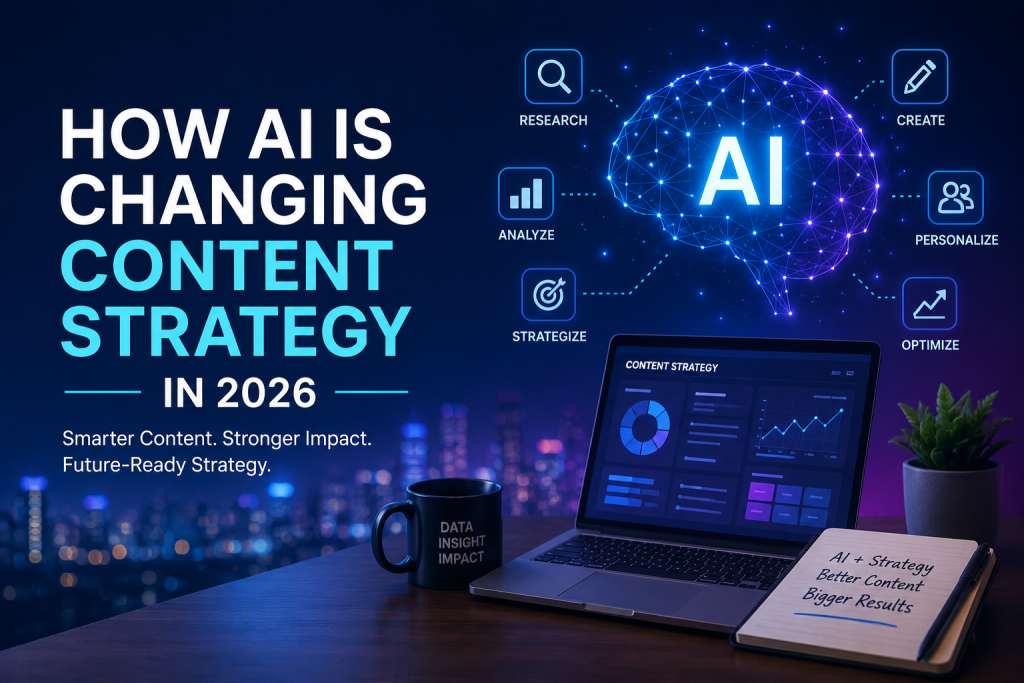
Content strategy has done more than simply “adopt” artificial intelligence; it has been reconstructed completely around it. AI offers a data-driven, fast, hyper-personalized method and technological ecosystem that allows companies of all sizes to reach audience in a more creative and precise manner than ever before.
Despite all of the advantages, the technology has also given rise to questions pertaining to ethics, authenticity, and skills required in the workforce. In this guide, you will learn how AI is truly creating a new game and playbook in terms of content creation. We encourage you to take a few moments to indulge in this easy-to-understand guide and consider how artificial intelligence can assist you in your content creation strategy.
AI has evolved from a novel type of a productivity booster into the infrastructure core of content strategies all over the globe. Today, marketers are not experimenting with AI tools in an isolated manner. They are actually integrating these tools into systems that cover content strategy from end-to-end. AI is handling research, creating ideation, general creation, optimization, the process of personalization, repurposing, and even in performance analysis. According to recent statistics, over 90% of all marketing teams now utilize artificial intelligence into their work-related tasks. 94% of all marketing firms use it for content strategy.
Due to this shift, there is now many significant changes in exactly how audiences discover the information that they are searching for and how they consume the information that they are presented with. There are several generative AI engines that have actually reduced click-through rates as we once knew. This forces brands to actually optimize for search rankings, but also for visibility within answers that are curated by AI. This is referred to as “Generative Engine Optimization” or “GEO” for short.
AI-Driven Discoverability and Visibility
It is a known fact that the process of keyword stuffing has actually given way to clarity on semantics and data that is structured. Websites that are AI ready have very clear statements in the opening. They also have a schema markup for the FAQs and services offered on the website, formatting that is consistent, and include detailed identity signals that AI has the ability to both parse and reuse.
Hyper-Personalization and Strategies That are Audience-Centric
AI is capable of hyper personalization using data and behavioral-based signals. The content delivered, the offers outlined, and the experiences presented to the user are able to be tailored to the individual or mini moments in the journey of the customer. Marketers are able to deploy AI agents in order to craft personalized content that adapts landing pages, email creation of sequences, and even chatbot responses.
Content Creation
Once a content strategy is put into place, artificial intelligence has the ability to create content on a scale and in a speed that is completely unprecedented. The generative aspect of AI is able to draft blog posts, copy, emails, and more. Human editors are still in demand to ensure accuracy, originality, and nuance.
Multi-modal content is the new default. In generates and edits videos, it can created images that are annotated, create audio explanations, and even elements that are interactive. Generative search engines prioritize this content because they reduce levels of ambiguity much better than just text. Short videos with explanations that include transcripts and structured text are known for earning citations in AI answers.
Structured Data and Machine Readability
Search engines and various AI models possess a unique power that allows them to thrive on data that is structured. The schema markup, the tagging per entity, and the graph optimization are all vital components to a content strategy. Artificial intelligence is capable of understanding the meaning of content and not simply what it says.
Increase Digital Presence to Rank Highly on AI-Driven Engines
Search engine optimization (SEO) used to be about ranking on the top of search engines. AI has changed that. Now, you will want to rank highly on AI-driven engines. Examples of these include Microsoft Copilot and the Search Generative Experience (SGE) by Google. The importance of these is that they are changing the means by which internet users are finding the information that they seek.
In the past, you would have to scan through the top blue links on a search engine results page. Now, users simply enter in the queries that they have into AI-based platforms and a summary is returned that was curated by artificial intelligence. This content is actually pulled out from many different sources that are authoritative in nature. Not only does content now have the ability to rank high on a search results page, but it also has the ability to earn a high level of inclusion by being presented in answers that are AI-generated on the top of a page.
AI produces authoritative content that is well interpreted by other AI. The content is typically structured well. When you create content, be sure to use headings that are clear, a detailed schema markup, and include a FAQs section that aids in the relevance of topics. You should also place an emphasis on the E-E-A-T signals. These include experience, expertise, authoritativeness, and trust.
Keyword Research and Search Intent is Being Redefined
The traditional usage of keywords is now officially “out”. Content that is intent-based in the latest and greatest and is officially “in”. Today’s content strategy does not use random and isolated keyword and keyword phrases, because this is not the way that internet users are engaging with various types of search engines and artificial intelligence platforms to discover the solutions that are provided by your business. You must create content that is outlined as to how people ask questions and to do that, it is important to know how they are conducting searches today. Then, shape the content creation process around these factors.
A Powerful Predictive
Predictive analytical tools are now capable of forecasting shifts among internet searchers. This helps brands to optimize their content prior to the trends peaking online. Advanced systems now track user intent, and competitive positioning in a real time manner. This helps marketers create content schedules that will be based on the actual emerging demand. This can be put out as far as 90 days in advance – which is an amazing feature of AI’s role on content strategy.
In addition to the above, there are several different tools that are capable of tracking the engagement metrics of a user like the depth in which they scroll, how long they are on the website and whether or not there are return visits to the website. These tools help to predict the performance of a website in a highly efficient manner.
AI may be used to build up content strategy workflows that will allow your marketing and content creation team to publish content fast so that when trends hit, you are on top of it. In addition to this, the algorithms are now able to tailor content to the demographics, the location, and the digital behavior of the internet user. If you are looking for local visibility, you can update your business profile on Google to succeed in the endeavor. You should combine SEO, GEO, and even AEO to meet people in whatever they elect to search for.
Increased Speed and High Levels of Efficiency
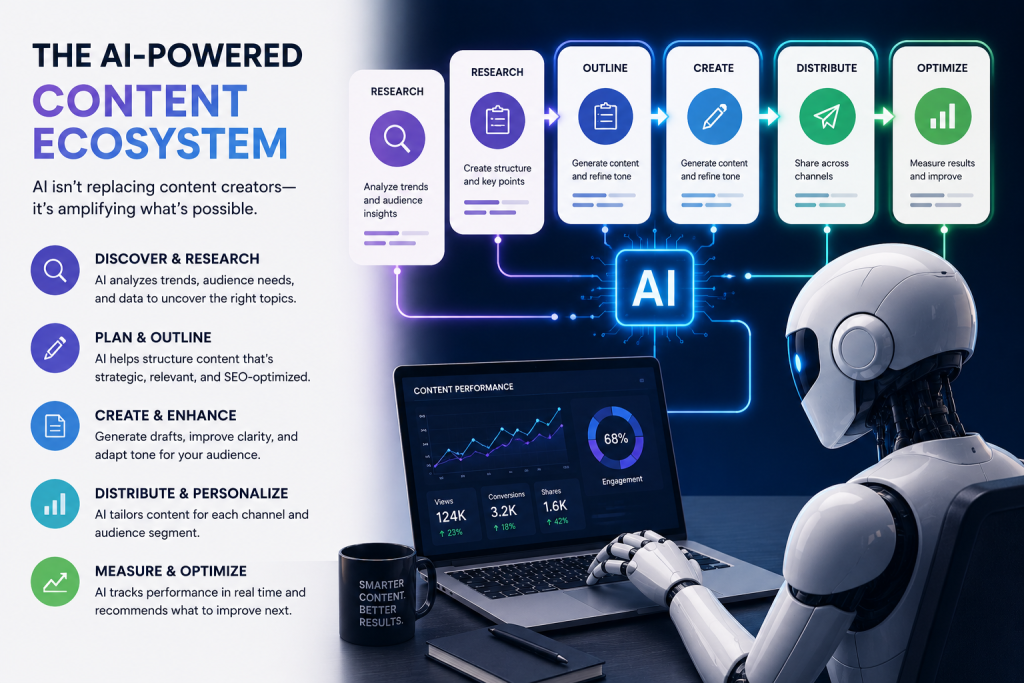
AI is known for accelerating the lifecycle of content. There are many tools that may be used to analyze vast levels of datasets. These will help in research, topic ideas, and to create outlines. AI can be used to create original drafts of articles, social media posts, emails, and even scripts in an instant fashion. These eliminate the amount of time that is spent on tasks like analyzing competitors, researching keywords and keyword phrases, the drafting of articles, and similar tasks. This will allow your marketing team move forward from ideas to publication at an accelerated rate.
Cost Efficiency and ROI
If you use artificial intelligence to automate your routine with your content creation strategy, it helps to speed things up and also aids in improving targeting and personalization. AI helped to reduce content production costs and boosts various types of performance metrics. Examples include engagement and conversions. Many companies report high gains in marketing efficiency and a solid return on investment. If you are ready to take your content strategy to new levels, we here at Brick Road Media encourage you to contact us today. We specialize in creating a website that is technology advanced, branding and rebranding, we create ecommerce websites, fix broken and hacked websites, and monthly websites. For more information, call us today at: 765-439-4029